

Glossary of Terms
A |
Aberration
A slight change in how an object appears because of movement or the way light bends. |
Absolute magnitude
How bright an object would look if it were placed at the same standard distance. |
Absorption line
A dark line in a spectrum where a gas has absorbed a particular colour of light. |
Accretion disc
A spinning disc of gas and dust that can form around a young star, a white dwarf, a neutron star or a black hole. |
Active galaxy
A galaxy with an unusually bright centre, powered by matter falling towards a huge black hole. |
Adaptive optics
Technology that changes a telescope mirror to reduce the blurring caused by Earth’s atmosphere. |
Airglow
A faint natural glow in Earth’s upper atmosphere, usually seen from very dark places. |
Airmass
The amount of atmosphere that light travels through before reaching a telescope. |
Albedo
How much light an object reflects. Snow has high albedo; charcoal has low albedo. |
Almanac
A book or website with useful sky information, such as rise and set times. |
Alt-azimuth mount
A telescope stand that moves up and down, and from side to side. |
Altitude
How high an object is above the horizon, measured in degrees. |
Amateur astronomer
A person who studies and enjoys astronomy without doing it as their main job. |
Analemma
The figure-of-eight shape made by recording the Sun’s position at the same time over a year. |
Andromeda Galaxy
The nearest large galaxy to the Milky Way. On a dark night, it can be seen without a telescope. |
Angular diameter
How wide an object appears in the sky, measured as an angle. |
Angular resolution
How close two objects can be before a telescope can no longer show them separately. |
Annular eclipse
A solar eclipse where the Moon is too small in the sky to cover all of the Sun, leaving a bright ring around it. |
Anorthosite
A pale rock common on the Moon’s highlands. |
Antenna
A device used to send or receive radio waves, including signals from spacecraft. |
Antimatter
Matter made of particles that are the opposite of ordinary matter. When the two meet, they can destroy each other and release energy. |
Aperture
The width of a telescope’s main lens or mirror. A larger aperture collects more light. |
Aphelion
The point in an object’s orbit when it is furthest from the Sun. |
Apoapsis
The furthest point in any orbit around an object. |
Apogee
The point in the Moon’s or a satellite’s orbit when it is furthest from Earth. |
Apparent magnitude
How bright an object appears to us in the sky. |
Apparent size
How large an object looks in the sky. This can be different from its real size. |
Arcminute
A small unit for measuring angles in the sky. There are 60 arcminutes in one degree. |
Arcsecond
A very small unit for measuring angles in the sky. There are 60 arcseconds in one arcminute. |
Artificial satellite
A human-made object placed in orbit around Earth or another body in space. |
Asterism
A familiar pattern of stars, such as the Plough or Orion’s Belt. It may be part of one constellation or use stars from several. |
Asteroid
A rocky object that travels around the Sun. |
Asteroid belt
A large region between Mars and Jupiter where many asteroids orbit the Sun. |
Asteroid family
A group of asteroids with similar orbits, often made when a larger asteroid broke apart. |
Asteroid moon
A small natural satellite that travels around an asteroid. |
Astrobiology
The study of life in space and whether it could exist beyond Earth. |
Astrometry
The careful measurement of the positions and movements of objects in space. |
Astronaut
A person trained to travel and work in space. |
Astronomical calendar
A calendar showing important sky events, such as eclipses and meteor showers. |
Astronomical dawn
The first faint light before sunrise, when the Sun is still far below the horizon. |
Astronomical dusk
The last faint light after sunset, when the Sun is far below the horizon. |
Astronomical twilight
The darkest part of twilight, when many stars become visible. |
Astronomy
The study of space and everything in it, such as planets, stars and galaxies. |
Astrophotography
Taking photographs of the Moon, planets, stars and other objects in space. |
Astrophysics
Using physics to understand how objects and events in space work. |
Atmosphere
The layer of gases around a planet, such as the air around Earth. |
Atmospheric refraction
The bending of light in Earth’s atmosphere, which can make objects look higher than they are. |
Aurora
Colourful lights in the sky, caused when particles from the Sun meet Earth’s atmosphere. |
Axis
An imaginary line through a planet that it spins around. |
Azimuth
The compass direction of an object along the horizon. |
|
B |
|
Bahtinov mask
A telescope accessory that makes focusing on stars easier for astrophotography. |
Bandpass
The range of colours or wavelengths that a filter allows through. |
Barnard’s Star
A nearby red dwarf star that moves quickly across our sky over many years. |
Barycentre
The balance point between two objects in orbit around each other. |
Baseline
The distance between two observing places, used to measure angles or make detailed radio images. |
Bayer notation
A way of naming stars in a constellation using Greek letters. The brighter stars often have the earlier letters. |
Big Bang
The name for the beginning of the Universe, when space began to expand. |
Binary star
Two stars held together by gravity as they orbit each other. |
Binoculars
Two small telescopes joined together, useful for exploring the Moon and bright groups of stars. |
Blackbody
An ideal object that gives off light based only on its temperature. |
Black hole
A place in space with such strong gravity that even light cannot escape. |
Blazar
A very bright galaxy centre whose jet is pointed almost directly at Earth. |
Blue giant
A very hot, bright and massive star that looks blue-white. |
Blue Moon
The second full Moon in a calendar month. It does not usually look blue. |
Bok globule
A small, dark cloud of gas and dust where stars may be forming. |
Bolide
A very bright meteor that may explode in the atmosphere. |
Brown dwarf
An object bigger than a planet but too small to shine like a normal star. |
|
C |
|
Carbon star
A cool red giant star with more carbon than oxygen in its outer layers. |
Cassegrain telescope
A telescope that uses mirrors to fold light into a shorter tube. |
Cassini Division
A dark gap between two of Saturn’s main rings. |
Catadioptric telescope
A telescope that uses both lenses and mirrors to focus light. |
Celestial equator
An imaginary line in the sky above Earth’s equator. |
Celestial navigation
Finding your direction or position by using the Sun, Moon and stars. |
Celestial pole
A point in the sky directly above Earth’s North or South Pole. |
Celestial sphere
An imaginary giant sphere around Earth that helps us map positions in the sky. |
Charge-coupled device
A light-sensitive electronic sensor used in many astronomy cameras. |
Chondrite
A stony meteorite containing tiny rounded grains formed early in the Solar System. |
Chromatic aberration
Colour fringes around an image caused when a lens focuses colours differently. |
Chromosphere
A thin layer of the Sun’s atmosphere above its visible surface. |
Circumpolar
Describes a star or constellation that never goes below the horizon from a particular place on Earth. |
Circumzenithal arc
A bright, upside-down rainbow-shaped arc high in the sky, made by ice crystals. |
Colliding galaxies
Galaxies passing through or merging with each other because of gravity. |
Collimation
Aligning a telescope’s mirrors or lenses so it gives a sharp image. |
Colour filter
A filter that lets through only selected colours of light. |
Colour temperature
A way of describing the colour of light by comparing it with a heated object. |
Coma
The fuzzy cloud of gas and dust around the centre of a comet. |
Comet
An icy object that can grow a glowing head and tail when it travels near the Sun. |
Cometary orbit
The long, stretched path followed by a comet around the Sun. |
Comet tail
A stream of dust or gas that points away from the Sun as a comet travels. |
Compact object
A very small, dense object, such as a white dwarf, neutron star or black hole. |
Computerised telescope
A telescope that uses a computer to help find and follow objects. |
Conjunction
When two objects appear close together in the sky from Earth. |
Constellation
A named area of the sky. The stars in a constellation may look like a pattern, but they are usually very far apart in space. |
Core
The central part of a planet, moon, star or galaxy. |
Corona
The outer, glowing part of the Sun’s atmosphere, easiest to see during a total solar eclipse. |
Coronal mass ejection
A huge cloud of charged gas thrown out from the Sun. |
Cosmic distance ladder
A set of methods astronomers use to measure distances farther and farther into space. |
Cosmic dust
Tiny solid particles in space, made from materials such as carbon, ice and rock. |
Cosmic inflation
The idea that the very early Universe expanded extremely quickly. |
Cosmic microwave background
Very faint heat left over from the early Universe, detected in every direction in space. |
Cosmic rays
Tiny, fast-moving particles from space that reach Earth. |
Cosmic web
The large-scale pattern of galaxies and gas spread through the Universe. |
Cosmology
The study of the Universe: how it began, how it changes and what it contains. |
Crater
A bowl-shaped hole on a planet or moon, often made by an impact. |
|
D |
|
Dark-sky reserve
A protected area where communities work to reduce light pollution. |
Dark-sky site
A place with little artificial light, making faint stars easier to see. |
Dark energy
The name given to something that seems to be making the Universe expand faster. |
Dark matter
Invisible matter that cannot be seen directly but has gravity. |
Dark nebula
A cloud of dust that blocks light from stars behind it. |
Day
The time Earth takes to spin once on its axis, about 24 hours. |
Declination
A way of describing how far north or south an object is in the sky. |
Deep-sky object
An object beyond our Solar System, such as a nebula, cluster or galaxy. |
Deep field
A long-exposure image of a small sky area that reveals very faint, distant galaxies. |
Dew shield
A tube that helps keep dew and stray light off a telescope lens. |
Diffraction
The spreading of light when it passes an edge or small opening. |
Direct imaging
Taking a picture of an object in space, rather than detecting it indirectly. |
Diurnal motion
The daily apparent movement of the sky caused by Earth spinning. |
Dome
A rounded building roof that protects a telescope and can open to the sky. |
Doppler effect
A change in a wave caused by movement. Astronomers use it to tell whether an object is moving towards or away from us. |
Double cluster
Two nearby open star clusters that look close together in the sky. |
Dust lane
A dark-looking band of dust that can be seen in some galaxies. |
Dust tail
A broad, curved comet tail made from dust pushed away by sunlight. |
Dwarf planet
A round object orbiting the Sun that is not large enough to clear other objects from its path. |
|
E |
|
Earth
The planet we live on. It is the third planet from the Sun. |
Earthshine
Sunlight reflected from Earth onto the dark part of the Moon, making it faintly visible. |
Eccentricity
A number that describes how circular or stretched an orbit is. |
Eclipse
When one object in space blocks the light from another. |
Ecliptic
The path the Sun appears to take across the sky. The Moon and planets are usually found close to this path. |
Electromagnetic radiation
Energy that travels as waves, including radio waves, visible light and X-rays. |
Electromagnetic spectrum
The full range of light and energy, from radio waves to gamma rays. |
Electron
A tiny particle with a negative electric charge. |
Elliptical galaxy
A round or oval galaxy with few young stars and little gas or dust. |
Elongation
The angle between the Sun and a planet or Moon as seen from Earth. |
Emission nebula
A cloud of gas that glows because nearby stars give it energy. |
Ephemeris
A table or calculation showing where an object will be in the sky at a certain time. |
Equatorial coordinate system
A sky map system that uses right ascension and declination. |
Equatorial mount
A telescope stand designed to follow the movement of stars across the sky. |
Equinox
A time in March or September when day and night are almost the same length. |
Escape velocity
The speed needed to escape an object’s gravity without more engine power. |
Evening star
A bright planet visible after sunset, often Venus. |
Event horizon
The boundary around a black hole beyond which nothing can escape. |
Exoplanet
A planet that orbits a star outside our Solar System. |
Exosphere
The very thin outer layer of a planet’s atmosphere. |
Extragalactic
Describes something outside the Milky Way galaxy. |
Eyepiece
The part of a telescope that you look through. |
|
F |
|
False colour
Colours added to an image to show details our eyes would not otherwise see. |
Fast radio burst
A very short, powerful flash of radio waves from deep space. |
Field of view
The amount of sky you can see through a telescope, binoculars or camera. |
Filter
A piece of material that blocks some light and lets selected light through. |
Finder scope
A small, wide-view telescope used to aim a larger telescope. |
Fireball
An especially bright meteor that can be seen over a wide area. |
First quarter
The Moon phase when half the visible face is lit and getting brighter. |
Flare star
A star that suddenly becomes brighter after releasing energy from its magnetic field. |
Focal length
A measurement that helps describe how much a telescope or camera magnifies an object. |
Focal plane
The place inside a telescope or camera where a focused image forms. |
Focus
Adjusting a telescope or binoculars until the view becomes sharp. |
Full Moon
The Moon when its whole face appears bright from Earth. |
|
G |
|
Galactic centre
The central region of the Milky Way, home to a huge black hole. |
Galactic halo
A large, faint region around a galaxy containing old stars, gas and dark matter. |
Galactic plane
The flat main disc of the Milky Way, where most of its stars and gas lie. |
Galaxy
A huge collection of stars, gas, dust and planets held together by gravity. |
Galaxy cluster
A group of galaxies held together by gravity. |
Galaxy merger
The joining of two or more galaxies because of gravity. |
Gamma-ray burst
A short, extremely powerful burst of gamma rays from a distant event. |
Gamma rays
The most energetic kind of light in the electromagnetic spectrum. |
Gas giant
A very large planet made mostly from gas, such as Jupiter or Saturn. |
Geocentric
Describes something viewed or measured with Earth at the centre. |
Geostationary orbit
An orbit high above Earth where a satellite stays above the same place on the ground. |
Giant molecular cloud
A huge, cold cloud of gas where many new stars can form. |
Gibbous Moon
The Moon when more than half, but not all, of its face looks bright. |
Globular cluster
A tightly packed, round group of many old stars. |
Gravitational lens
A massive object bending light from something behind it, like a natural magnifying glass. |
Gravitational waves
Tiny ripples in space and time caused by very massive objects moving. |
Gravity
The pulling force that attracts objects towards one another. |
Great Red Spot
A huge, long-lasting storm in Jupiter’s atmosphere. |
|
H |
|
H-alpha
A deep red kind of light from hydrogen gas, useful for viewing the Sun and nebulae. |
Habitable planet
A planet with conditions that might allow liquid water on its surface. |
Habitable zone
The region around a star where a planet could have liquid water. |
Half Moon
The Moon when half of the face we can see is lit by the Sun. |
Heliocentric
Describes something viewed or measured with the Sun at the centre. |
Heliopause
The outer boundary of the Sun’s influence, where the solar wind meets interstellar space. |
Helioseismology
The study of waves moving through the Sun to learn about its inside. |
Heliosphere
The bubble around the Sun filled by the solar wind. |
Helium
A very light gas made in stars and the second most common element in the Universe. |
Helium flash
A sudden start of helium fusion in the core of some ageing stars. |
Hertzsprung-Russell diagram
A chart that groups stars by their brightness and temperature. |
Horizon
The line where the sky appears to meet the ground. |
Hot Jupiter
A gas giant planet that orbits very close to its star. |
Hour angle
A measurement showing how far an object is from its highest point in the sky. |
Hubble constant
A number that describes how quickly the Universe is expanding. |
Hubble Space Telescope
A space telescope that has taken detailed pictures of planets, stars and distant galaxies. |
Hydrogen
The lightest and most common element in the Universe. Stars use it as fuel. |
Hydrostatic equilibrium
A balance between gravity pulling inward and pressure pushing outward in a star or planet. |
|
I |
|
Ice giant
A large, cold planet made mainly of gases and icy materials, such as Uranus or Neptune. |
Impact
A collision between objects in space, such as an asteroid hitting a moon. |
Inclination
The angle of an orbit compared with another orbit or surface. |
Inferior conjunction
When Mercury or Venus passes between Earth and the Sun. |
Inferior planet
A planet whose orbit is closer to the Sun than Earth’s orbit. |
Infrared
A kind of light we cannot see with our eyes but can detect as heat. |
Inner planet
A planet in the inner Solar System, close to the Sun. |
Interferometer
Several telescopes working together to show finer detail than one telescope alone. |
International Space Station
A large space laboratory where astronauts from different countries live and work. |
Interplanetary space
The space between planets in a solar system. |
Interstellar cloud
A cloud of gas and dust between stars. |
Interstellar medium
The thin gas and dust found in the space between stars. |
Interstellar space
The space between stars in a galaxy. |
Ionosphere
A high layer of Earth’s atmosphere with electrically charged particles. |
Ion tail
A straight comet tail made of electrically charged gas pushed away by the Sun’s wind. |
Irregular galaxy
A galaxy with no clear regular shape. |
|
J |
|
James Webb Space Telescope
A large space telescope designed mainly to observe infrared light. |
Jet
A narrow, fast stream of particles shot out from some objects in space. |
Jupiter
The largest planet in our Solar System and the fifth planet from the Sun. |
|
K |
|
Keplerian orbit
An orbit that follows the rules discovered by Johannes Kepler. |
Kepler’s laws
Three rules that describe how planets move around the Sun. |
Kuiper Belt
A distant region beyond Neptune containing icy objects, including some dwarf planets. |
|
L |
|
Lagrange point
A place in space where gravity allows a smaller object to stay in a steady position near two larger objects. |
Latitude
A measurement of how far north or south a place is on Earth. It affects which stars you can see. |
Launch
The moment a rocket takes off from Earth. |
Lenticular galaxy
A galaxy shaped like a disc and central bulge, but without clear spiral arms. |
Libration
A gentle rocking movement that lets us see a little more than half of the Moon over time. |
Light-year
The distance light travels in one year. It is a measure of distance, not time. |
Light curve
A graph showing how an object’s brightness changes over time. |
Light pollution
Unwanted artificial light that makes stars harder to see. |
Limb
The outer edge of the visible disc of the Sun, Moon or planet. |
Local Group
The small group of galaxies that includes the Milky Way and Andromeda Galaxy. |
Low Earth orbit
An orbit fairly close to Earth, used by the International Space Station and many satellites. |
Luminosity
The total amount of light and energy an object gives out. |
Lunar eclipse
When Earth’s shadow falls on the Moon. |
Lunar maria
Large, dark plains on the Moon formed by ancient lava flows. |
Lunar orbit
The path followed by an object travelling around the Moon. |
Lunar phase
The changing shape of the Moon that we see from Earth. |
Lunar terminator
The moving line between day and night on the Moon. |
|
M |
|
Magellanic Clouds
Two small galaxies that orbit the Milky Way and can be seen from the southern hemisphere. |
Magnetic field
An invisible area around a magnet or planet where magnetic forces act. |
Magnetic storm
A disturbance in Earth’s magnetic field caused by activity from the Sun. |
Magnetosphere
The area around a planet controlled by its magnetic field. |
Magnetotail
The long stretched-out part of a planet’s magnetosphere on the side away from the Sun. |
Magnitude
A number used to describe how bright an object looks in the sky. Smaller numbers mean brighter objects. |
Main sequence
The long, stable part of a star’s life, when it makes energy by changing hydrogen into helium. |
Mare
A dark plain on the Moon, formed long ago by lava. |
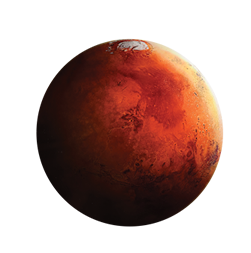
Mars
The fourth planet from the Sun, often called the Red Planet because of its rusty-looking surface. |
Mars rover
A robot vehicle sent to explore the surface of Mars. |
Mass
The amount of matter in an object. More mass means stronger gravity. |
Mercury
The closest planet to the Sun and the smallest planet in our Solar System. |
Messier object
One of the bright deep-sky objects listed by astronomer Charles Messier, including star clusters, nebulae and galaxies. |
Meteor
A streak of light made when a small piece of space rock burns up in Earth’s atmosphere. It is often called a shooting star. |
Meteorite
A piece of space rock that survives its journey through the atmosphere and lands on Earth. |
Meteoroid
A small piece of rock or metal travelling through space. |
Meteor shower
An event when many meteors appear to come from the same part of the sky. |
Microlensing
A brief brightening caused when an object’s gravity bends and focuses light from a distant star. |
Micrometeorite
A very tiny meteoroid that can reach Earth’s surface. |
Milky Way
The galaxy that contains our Solar System. |
Minor planet
A small object orbiting the Sun that is not a major planet, such as an asteroid. |
Molecular cloud
A cold cloud containing molecules, often where new stars form. |
Moon
A natural object that travels around a planet. |
Moonquake
A shaking movement on the Moon, similar to an earthquake on Earth. |
Moonrise
The time when the Moon first appears above the horizon. |
Moonset
The time when the Moon disappears below the horizon. |
Morning star
A bright planet visible before sunrise, often Venus. |
Multiple star
Three or more stars held together by gravity. |
|
N |
|
Nadir
The point in the sky directly below your feet. |
Naked-eye astronomy
Looking at the sky without using a telescope or binoculars. |
Natural satellite
A natural object that orbits a planet, such as the Moon. |
Neap tide
A smaller-than-usual tide when the Sun and Moon pull from different directions. |
Near-Earth object
An asteroid or comet whose orbit brings it close to Earth’s orbit. |
Near side
The half of the Moon that usually faces Earth. |
Nebula
A huge cloud of gas and dust in space, where stars can be born. |
Neptune
The eighth and most distant planet from the Sun. |
Neutral density filter
A filter that reduces light evenly without changing its colour. |
Neutron star
An incredibly small, dense star left behind after a huge star explodes. |
New Moon
The Moon when its sunlit side faces away from Earth, making it very difficult to see. |
Newtonian telescope
A reflecting telescope that uses a curved primary mirror and a flat secondary mirror. |
Night sky
The sky as seen after dark, including the Moon, planets, stars and other space objects. |
Noctilucent clouds
Very high clouds that can glow after sunset because sunlight still reaches them. |
Noon
The time when the Sun is highest in the sky for that day. |
North Star
Polaris, a star that appears almost directly above Earth’s North Pole. |
Nova
A sudden brightening of a star caused by an explosion on its surface. |
Nuclear fusion
The joining of small atomic nuclei to release energy, which powers stars. |
Nucleus
The solid, icy centre of a comet. |
|
O |
|
Objective lens
The large front lens of a refractor telescope or binoculars. |
Observatory
A place with telescopes and other equipment for studying space. |
Occultation
When one object in space passes in front of another and hides it from view. |
Occulting disc
A small disc used to block bright light so fainter nearby objects can be seen. |
Omega Centauri
A bright globular cluster visible from southern skies and low in the UK sky. |
Oort Cloud
A possible enormous cloud of icy objects far beyond the planets, thought to be where many comets begin. |
Open cluster
A loose group of stars that formed from the same cloud of gas and dust. |
Opposition
When a planet is opposite the Sun in our sky and is usually easier to see. |
Optical telescope
A telescope that collects visible light. |
Orbit
The curved path an object follows as it travels around another object. |
Orbital period
The time an object takes to complete one orbit. |
Orbital plane
The flat surface in which an object’s orbit lies. |
Outer planet
A planet whose orbit is farther from the Sun than Earth’s orbit. |
|
P |
|
Parabolic mirror
A curved mirror shape that brings parallel light rays to a single focus. |
Parallax
The apparent shift in an object’s position when it is viewed from different places. Astronomers use it to measure distances to nearby stars. |
Parsec
A distance used by astronomers, equal to about 3.26 light-years. |
Partial eclipse
An eclipse where only part of the Sun or Moon is covered. |
Penumbra
The lighter outer part of a shadow during an eclipse. |
Perigee
The point in the Moon’s or a satellite’s orbit when it is closest to Earth. |
Perihelion
The point in an object’s orbit when it is closest to the Sun. |
Photometry
Measuring the brightness of objects in space. |
Photon
A tiny packet of light energy. |
Photosphere
The bright visible surface of the Sun or another star. |
Planet
A large, nearly round object that orbits a star. |
Planetarium
A place or dome where the night sky and space can be projected for people to explore. |
Planetary nebula
A glowing shell of gas released by a dying star. It has nothing to do with planets. |
Planetary system
A star and the planets, moons and smaller objects orbiting it. |
Planetesimal
A small early building block that can join with others to form planets. |
Planisphere
A rotating star map that helps you find which constellations are visible at a chosen date and time. |
Plasma
A very hot gas whose particles carry electric charge. Stars are mostly plasma. |
Polar alignment
Setting a telescope mount to point towards the celestial pole. |
Polaris
The North Star, which appears almost above Earth’s North Pole. |
Polar orbit
An orbit that passes over or close to a planet’s poles. |
Precession
The very slow change in the direction of Earth’s axis over thousands of years. |
Primary mirror
The main large mirror that collects light in a reflecting telescope. |
Prograde motion
Movement around an object in the same direction as that object spins. |
Proper motion
A star’s slow movement across the sky compared with more distant stars. |
Proton
A tiny particle with a positive electric charge, found in an atom’s centre. |
Protostar
A young forming star that has not yet begun normal hydrogen fusion. |
Pulsar
A rapidly spinning neutron star that sends out regular beams of energy. |
|
Q |
|
Quadrantids
A meteor shower seen each January, named after an old constellation. |
Quasar
An extremely bright, distant galaxy centre powered by a huge black hole. |
|
R |
|
Radial velocity
How fast an object is moving towards or away from us. |
Radiant
The point in the sky that meteors in a meteor shower appear to come from. |
Radiation
Energy that travels through space as waves or tiny particles. |
Radiation pressure
A tiny push caused when light or other radiation hits an object. |
Radio galaxy
A galaxy that gives off strong radio waves, often from giant jets. |
Radio source
Any object in space that produces radio waves. |
Radio telescope
A telescope that collects radio waves from space instead of visible light. |
Radio waves
Long-wavelength light that can travel through clouds and dust. |
Rayleigh scattering
The scattering of light by tiny particles, which helps make Earth’s sky look blue. |
Re-entry
The return of a spacecraft or space debris through Earth’s atmosphere. |
Red giant
A very large star in a late stage of its life. |
Redshift
When light from an object is stretched towards red, often showing that it is moving away from us. |
Reflectance
The fraction of light that a surface reflects. |
Reflector telescope
A telescope that uses mirrors to collect light. |
Refraction
The bending of light as it passes from one material into another. |
Refractor telescope
A telescope that uses glass lenses to collect and bend light. |
Regolith
Loose dust, soil and broken rock covering the surface of a moon, asteroid or planet. |
Remote observatory
An observatory that can be operated from somewhere else using the internet. |
Resolution
How much detail a telescope or image can show. |
Retrograde motion
An apparent backwards movement of a planet against the background stars. |
Revolution
One complete journey of an object around another object, such as Earth’s yearly trip around the Sun. |
Rift
A dark gap in the Milky Way caused by dust blocking starlight. |
Right ascension
A sky coordinate like longitude, used to describe an object’s east-west position. |
Ring system
A wide, flat group of ice, rock and dust particles orbiting a planet. |
Roche limit
The distance within which gravity can pull a moon or object apart. |
Rocket
A vehicle that uses powerful engines to travel into space. |
Rotation
One complete spin of an object around its own axis. |
Rubble pile
An asteroid made from many pieces of rock loosely held together by gravity. |
|
S |
|
Satellite
An object that travels around a planet. It can be natural, like the Moon, or human-made. |
Satellite constellation
A group of satellites working together for a shared purpose. |
Satellite dish
A bowl-shaped aerial used to collect radio signals from space. |
Satellite galaxy
A smaller galaxy that orbits a larger galaxy. |
Satellite navigation
Finding a position on Earth using signals from satellites. |
Saturn
The sixth planet from the Sun, famous for its bright ring system. |
Schmidt-Cassegrain telescope
A compact telescope that uses mirrors and a special glass plate. |
Schwarzschild radius
The size an object would need to become a black hole. |
Scintillation
The twinkling of stars caused by moving air in Earth’s atmosphere. |
Secondary mirror
A smaller mirror that redirects light inside some reflecting telescopes. |
Seeing
How steady the air is above a telescope. Poor seeing makes stars appear to twinkle and blur. |
Semimajor axis
Half the longest width of an oval orbit. |
SETI
The search for possible signals from intelligent life beyond Earth. |
Shadow transit
When the shadow of a moon falls across the face of its planet. |
Sidereal day
The time Earth takes to spin once compared with the distant stars, about four minutes shorter than a solar day. |
Skyglow
The bright glow above towns and cities caused by artificial lights. |
Sky survey
A planned project that repeatedly maps large areas of the sky. |
Small Solar System body
A small object orbiting the Sun, such as an asteroid or comet. |
Solar analogue
A star that is similar to the Sun. |
Solar cycle
The roughly 11-year pattern of changing activity on the Sun. |
Solar day
The time from one noon to the next, about 24 hours. |
Solar eclipse
When the Moon passes between Earth and the Sun and blocks some or all of the Sun’s light. |
Solar flare
A sudden burst of energy from the Sun. |
Solar maximum
The busy part of the Sun’s activity cycle, when more sunspots and solar flares are likely. |
Solar minimum
The quiet part of the Sun’s activity cycle, when there are fewer sunspots and solar flares. |
Solar prominence
A huge loop or arch of glowing gas that rises from the Sun’s surface. |
Solar System
The Sun and everything held in orbit around it, including planets, moons and smaller objects. |
Solar telescope
A telescope made for safely observing the Sun. Never look at the Sun with ordinary binoculars or a telescope. |
Solar transit
When Mercury or Venus passes across the face of the Sun as seen from Earth. |
Solar wind
A stream of tiny particles constantly flowing out from the Sun. |
Solstice
A day when the Sun reaches its highest or lowest point in the sky for the year. These are the longest and shortest days. |
Spacecraft
A vehicle made to travel or work in space. |
Space debris
Unused human-made objects and fragments left in orbit around Earth. |
Space elevator
A possible future transport system using a cable reaching from Earth into space. |
Space probe
An uncrewed spacecraft sent to explore space or another world. |
Space station
A large spacecraft where people can live and work in orbit. |
Space suit
A protective suit that lets astronauts survive in space. |
Space telescope
A telescope in space, above Earth’s atmosphere. |
Spacewalk
When an astronaut works outside a spacecraft while in space. |
Space weather
Changes in space caused by the Sun that can affect satellites, radio signals and auroras. |
Spectral class
A group for stars based on their temperature and colour. |
Spectral line
A bright or dark line in a spectrum that reveals which elements are present. |
Spectrograph
An instrument that spreads light into a spectrum for study. |
Spectrometer
An instrument that measures the strength of different colours or wavelengths of light. |
Spectroscopy
Studying spectra to learn what objects in space are made of. |
Spectrum
Light separated into its different colours, like a rainbow. |
Spicule
A short-lived jet of gas rising from the Sun’s lower atmosphere. |
Spiral galaxy
A galaxy with a flat disc and curved arms that spiral out from its centre. |
Spring tide
An extra-high and extra-low tide that happens when the Sun, Moon and Earth are lined up. It is not linked to the spring season. |
Star
A huge, glowing ball of hot gas that makes its own light and heat. |
Star atlas
A book or digital collection of maps of the night sky. |
Star chart
A map of the night sky that helps you find stars and constellations. |
Star cluster
A group of stars that formed near each other and travel through space together. |
Star colour
The colour of a star, which gives clues about its temperature. |
Star formation
The process of making new stars from collapsing gas and dust. |
Stargazing
Looking at and enjoying the night sky. |
Star hopping
Finding an object by moving step by step from familiar stars. |
Star system
One or more stars and any objects held in orbit around them. |
Star trail
The curved lines stars seem to make in a long-exposure photograph because Earth is rotating. |
Stellar evolution
The changes a star goes through during its lifetime. |
Stellar flare
A powerful burst of energy from the surface of a star. |
Stellar nursery
A region of gas and dust where new stars are forming. |
Stellar parallax
The tiny apparent shift of a nearby star as Earth moves around the Sun. |
Sublimation
When a solid changes directly into a gas without becoming liquid first. |
Submillimetre astronomy
The study of very short radio waves from cold dust and gas in space. |
Sun
The star at the centre of our Solar System. |
Sun dog
A bright patch of light beside the Sun, made by ice crystals in the air. |
Sunrise
The time when the Sun first appears above the horizon. |
Sunset
The time when the Sun disappears below the horizon. |
Sunspot
A darker, cooler-looking area on the Sun’s surface caused by its magnetic field. |
Supermoon
A full Moon that looks slightly larger and brighter because it is near its closest point to Earth. |
Supernova
A powerful explosion that happens when some stars reach the end of their lives. |
Synchronous orbit
An orbit that takes the same time as a planet takes to spin once. |
|
T |
|
Telescope
An instrument that helps us see distant objects in space more clearly. |
Telescope dome
A protective rounded building that houses a telescope. |
Telescope mount
The stand that holds a telescope and lets it point at the sky. |
Telrad
A finder that projects circles onto the sky to help aim a telescope. |
Terrestrial planet
A rocky planet with a solid surface, like Earth, Mars, Venus or Mercury. |
Thermal radiation
Energy given off as heat by an object. |
Tidal force
A difference in gravity across an object. The Moon’s tidal force helps cause ocean tides on Earth. |
Tidal locking
When a moon spins once in the same time it takes to orbit, always showing one face. |
Titan
Saturn’s largest moon, with a thick atmosphere and lakes of liquid hydrocarbons. |
Total eclipse
An eclipse where the Sun or Moon is completely covered from the viewer’s location. |
Totality
The period during a total eclipse when the Sun or Moon is completely covered. |
Transit
When one object passes in front of another, as seen from Earth. |
Transit method
A way of finding exoplanets by measuring a small dip in a star’s brightness. |
Triangulation
Finding distance or position by measuring angles from two or more places. |
Trojan asteroid
An asteroid sharing a planet’s orbit, usually travelling ahead of or behind it. |
Turbulence
Chaotic movement in the air that can blur telescope views. |
Twilight
The time before sunrise or after sunset when the sky is still partly lit. |
|
U |
|
Ultraviolet
A kind of light with more energy than visible light. It is invisible to our eyes. |
Umbra
The darkest central part of a shadow during an eclipse. |
Universe
Everything that exists: space, time, matter, energy, planets, stars and galaxies. |
Uranus
The seventh planet from the Sun, an ice giant that spins on its side. |
|
V |
|
Vacuum
A space with very little matter in it. |
Variable star
A star whose brightness changes over time. |
Venus
The second planet from the Sun and often the brightest planet in our sky. |
Visible light
The small part of the electromagnetic spectrum that human eyes can see. |
|
W |
|
Waning Moon
The Moon when the bright part we can see is getting smaller. |
Wavelength
The distance between matching points on a wave, used to describe types of light. |
Waxing Moon
The Moon when the bright part we can see is getting larger. |
Weightlessness
The feeling of not having weight while falling freely in orbit. Gravity is still present. |
White dwarf
The hot, small remains of a star like the Sun after it has used up its fuel. |
Winter Hexagon
A large pattern of bright stars that can be seen in the northern winter sky. |
|
X |
|
X-ray astronomy
The study of X-rays from space, which can reveal very hot and energetic objects. |
X-ray binary
A pair of stars where one object pulls gas from the other and produces X-rays. |
|
Y |
|
Year
The time Earth takes to travel once around the Sun, about 365 and a quarter days. |
|
Z |
|
Zenith
The point in the sky directly above your head. |
Zodiac
The band of sky around the ecliptic. The zodiac constellations lie in this band; this is different from astrology. |
Zodiacal light
A faint, triangle-shaped glow sometimes seen after sunset or before sunrise, caused by dust in the Solar System. |
 Meet the Team
 What we do
 How you can support us




Achievement of the quality mark by UK Astronomy demonstrates to funders and other stakeholders their commitment to excellence.
Ian McLintock,
Founder,
Charity Excellence.
© Copyright 2021 - , UK Astronomy, All rights reserved.
UK Astronomy is a registered charity in England and Wales (1190172)
and a company Limited by Guarantee (10276672)
Registered Office: 3 Pleshey Close, Milton Keynes, MK5 6EP
PLEASE NOTE: This address is NOT a visitor, retail or collection address. It is purely for correspondence only.
Website Designed & Maintained by Visual Interactive